


Research objective: To identify and classify wood residues and reclaimed wood available in Latvia, assessing their potential for the production of high-value and long-lasting products. The project will develop a resource mapping and quality classification system that will allow determining the origin, properties and suitability of different residue categories for specific applications. In parallel, criteria for high-value recycling will be defined and practical principles for reuse will be formulated.
Based on the developed criteria, product concepts will be created for different types of materials, their compliance with technical requirements will be tested in the laboratory, and prototypes with a “reuse” index will be manufactured, which will demonstrate the possibilities of assembly and disassembly.
The project will provide practically usable solutions that will confirm the potential of reclaimed wood to become a sustainable, locally available resource in construction and product development. As a result, a scientifically sound basis will be created for the development of new, environmentally friendly and competitive wood products.
Project period: April 2026 – September 2027.
Project implementer: SIA “Forest and Wood Products Research and Development Institute”.
The project is implemented within the MNKC support fund program 1.2.1.2.i.2. “Green Products” (CFLA contract No. 1.2.1.2.i.2/1/24/A/CFLA/001)
ZP18 Project Progress: Reclaimed Wood Source Mapping System Developed
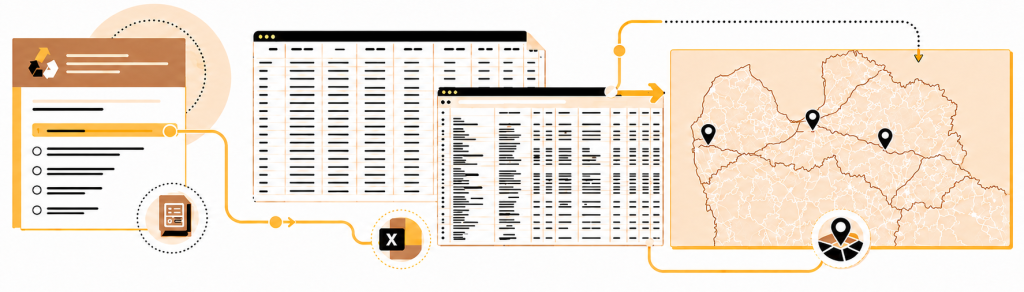
In June 2026, the first research activity of the ZP18 project was completed. Its objective was to map reclaimed wood sources in Latvia. The main result is a reclaimed wood source mapping system based on a unified resource classification and data structure.
The mapping system is more than a geographical map. It links each resource source and location to the material type, origin, quantity, regularity of availability, initial condition and availability of samples. Researchers use a standardised questionnaire to collect data, allowing them to systematically record and practically verify the actual presence of reclaimed materials at specific locations. The collected data are automatically stored in a SharePoint Excel data matrix and, following verification, used for spatial visualisation in QGIS.
The mapping system is currently partially automated. Data are collected and stored automatically, while verified data are added to and updated on the map through a controlled manual process. At present, the system is used exclusively to support subsequent activities within the ZP18 project. These include comparing different resource groups, selecting representative samples and planning the laboratory testing of materials.
The project implementers hope that the solution developed could eventually evolve into a continuously operating self-service platform for reclaimed resources. Resource owners could use the platform to add and update information about available materials, while potential users and product manufacturers could easily identify resources suited to their needs. Such a platform could become a practical meeting point for reclaimed resource owners and potential users, promoting material reuse and the production of high value-added products.
The second project activity is currently underway. Its objective is to develop a quality classification system and conduct laboratory validation. The methodological framework for the classification system has been prepared, but the system cannot yet be considered a completed and fully validated final result.
One of the initial stages of the second activity involved reviewing existing experience in Latvia and internationally. This research was conducted to assess the current situation in reclaimed wood quality classification, resource mapping and reuse, and to provide a stronger basis for planning the subsequent work of the ZP18 project.
The monitoring database contains 20 records covering 18 unique Latvian and international projects and initiatives. Of these, 13 projects were assessed as having a high or very high thematic similarity to ZP18. The analysis covered quality assessment methods, circularity and data approaches, resource mapping and reuse solutions.
The findings have informed the development of ZP18 terminology, the data structure, parameters to be tested and the classification logic, adapting them to reclaimed wood resource flows in Latvia. A sample and test data matrix has been created, together with a traceable data linkage logic. This begins with recording the origin and initial condition of each sample and continues through the assessment of its physical, mechanical and chemical properties, risk interpretation and a decision on the material’s potential application.
The results of this initial research stage are presented in two accompanying information materials:
“Reclaimed Wood in the European Research Area” presents a comparative analysis of ZP18 in the context of European research and innovation projects.
“Reclaimed Wood: Project Map” provides an overview of Latvian and international projects, describing their main areas of activity and the most significant findings for ZP18.
Work on the second activity is continuing. The next steps include obtaining samples, conducting laboratory validation and validating the classification threshold values.


